


“Can I make this in a different-sized tin?” is a question I get asked a lot. And I completely get it! You’ve found the cake you want to bake, you’ve got the ingredients… and the recipe asks for two round tins when you’ve only got one square one. Typical.
So I’ve put together this cake tin calculator to help you work out how much mixture you’ll need. Whether you’re making a smaller cake, swapping round for square or turning a sponge into cupcakes, it gives you a number to multiply your cake mixture ingredients by.
Hopefully that means a little less head-scratching and a little more cake. Always a good thing, if you ask me!
Jump to a section

What is a cake tin calculator, and when should I use it?
A cake tin calculator helps you adjust the quantities in a recipe when you want to change the size, shape or number of tins you’re using.
Simply pouring the original mixture into a different tin can leave you with a cake that’s much thinner or deeper than you expected. Sometimes there’s far too much mixture to fit in the tin at all! It helps you work out how much mixture you’ll need for your tin.
The calculator compares your original tins with the ones you want to use and gives you an ingredient multiplier. That just means a number to multiply each amount by, so you keep the ingredients in the same proportions.
You can also use it to adjust how many cupcakes you’re making or estimate a swap between a cake tin and cupcake cases.
How do I use the cake tin calculator?
You’ll need the recipe you’re making and the size of your own tin. Then follow these steps.
- Check what the original recipe asks for. Find the tin shape, size and number of tins in the recipe. If it uses two 20cm round tins, make sure “Number of tins” is set to 2.
- Fill in “The recipe uses”. Choose the original tin type, select inches or centimetres, enter the size and add the number of tins. For a round tin, the diameter means the distance straight across the middle. For a square tin, enter one side. For a rectangular tin, enter its length and width.
- Fill in “I want to use”. Enter the details of your own tin or tins in the same way. If you choose a 1lb or 2lb loaf tin, you won’t need to enter measurements. For cupcakes, choose “Muffin/cupcake tin” and enter the total number of cupcakes the recipe makes or the number you want to make, depending on which side you’re filling in.
- Read the number underneath. The result updates automatically as you change the details. A number above 1 means you’ll need more mixture than the original recipe stated. A number below 1 means you’ll need less. If it says 1, keep the original ingredient quantities.
- Multiply each cake mixture ingredient by that number. You can use the calculator on your phone for this bit. For example, if the result is 1.5, an ingredient listed as 200g becomes 300g because 200 × 1.5 = 300. Do the same for the other ingredients, including liquids and ingredients measured in teaspoons. Write down your new quantities before you start mixing!
A few important notes before you start
Changing tin size will affect the baking time. A larger or deeper cake may need longer in the oven, while smaller cakes and cupcakes will usually bake faster. Keep a close eye on things and, for a sponge cake, check the centre with a skewer. It should come out clean, without wet mixture. For a better idea of timing, look at a similar recipe of mine baked in the same type and size of tin, whether that’s a rectangular tin, two 8-inch round tins or cupcakes. Keep the recipe’s temperature as a starting point and use those timings as a guide, checking early.
- Part of an egg? Use the egg size in the original recipe (medium or large usually depending on the recipe). If you need 2½ eggs, use two whole eggs, then beat another egg and weigh out half of it, without the shell. Please don’t just round up or down and hope for the best!
- Leave room for the cake to rise. The results are a guide based on the tin sizes and depth assumptions explained below. Don’t fill a tin to the brim just to use up the mixture.
- Scaled icing quantities are a guide. Yes, start with the same multiplier for your icing ingredients. But bear in mind you may need less than this amount if you’re making a deeper cake with icing only on top, or turning a filled, fully iced layer cake into a loaf with just a topping.
Cake tin calculator FAQs
How do I measure my cake tin?
Measure across the inside of the tin, leaving out the rim, handles and any overhanging edges. For a round tin, measure straight across the centre. For a square tin, measure one side. For a rectangular tin, measure both the length and width.
Use the same unit for all the measurements on that side of the calculator. You can use centimetres for the original tin and inches for the new one if you need to.

Should I choose “Round” or “Round (deep)”?
Choose “Round” for a regular sandwich tin and “Round (deep)” for a deep round cake tin. The calculator uses a depth of 4.5cm for regular round, square and rectangular tins, and 9cm for deep round tins.
The deep setting assumes you’re making a deeper cake. If you’re simply using a taller tin for the same depth of mixture, you don’t need extra ingredients.
These are the calculator’s assumptions, rather than standard measurements for every tin sold. If yours is much deeper or shallower, the result will be less reliable. The calculator doesn’t currently accept a separate depth measurement.
Can I bake a two-layer cake in one deep tin?
Sometimes, depending on the recipe. A deep tin may hold the mixture for two separate layers, but that doesn’t mean the recipe will bake the same way.
But putting all the mixture into one tin creates a deeper cake. It can take considerably longer to bake, and some recipes won’t bake evenly this way. Keep any recipe-specific advice about baking the layers separately.
Is a 2lb loaf tin twice the size of a 1lb loaf tin?
You’d think so, wouldn’t you? Unfortunately, those labels don’t guarantee a particular capacity, and sizes vary between brands.
That’s why the calculator uses measurements for its loaf estimates. Check the reference sizes below against your own tins, especially if you’re using a different brand.
Which loaf tin sizes does the calculator use?
The loaf estimates use the published dimensions of the Tala Performance tins I use. The 1lb tin measures 19.1 × 9 × 6.5cm, and the 2lb tin measures 22.9 × 12.7 × 7cm.
The estimates use those dimensions, so they won’t account perfectly for sloping sides or a different brand’s tin. They aim for a similar proportion of each tin to be filled. If your loaf tin is noticeably different, treat the result as a rough guide.
How accurate are the cupcake conversions?
They’re a useful starting point for everyday sponge recipes, but the amount of mixture each case needs will depend on its size and how much you fill it.
The cupcake estimate is based on my Victoria sponge and vanilla cupcake recipes, which use the same quantities for the sponge mixture. My vanilla cupcake recipe makes at least 12 standard cupcakes, and the calculator uses 12 cupcakes for two 20cm sandwich tins as its reference.
Other recipes and case sizes can give different yields, so this is an estimate rather than a promise that every cake recipe will produce exactly that number.
Do I enter the number of cupcake trays or the number of cupcakes?
Enter the total number of cupcakes. If you want 24 cupcakes, enter 24, even if you only have one tray and need to bake them in batches.
On the recipe side, enter how many cupcakes the full original recipe makes. The number of holes in your tray doesn’t change that.

Does it work for mini cupcakes or jumbo muffins?
The cupcake setting is based on standard-sized cupcakes. Mini cases need less mixture and jumbo cases need more, so the same number won’t give a reliable conversion.
If you’re simply changing the quantity of an existing mini or jumbo recipe, you can still scale by yield. For example, making 24 instead of 12 uses twice the recipe, provided you keep the same case size and fill level.
Do I divide the ingredients between the tins afterwards?
Yes. The multiplier adjusts the whole recipe, so work out your new ingredient quantities, make the mixture, then divide it between the tins you entered.
For example, if the calculator gives you 1.5 for three tins, make one-and-a-half times the original recipe in total. You don’t need that amount for each tin!
How long do cakes usually take to bake in different tins?
Here’s roughly how long I bake a few of my cakes in these tins. Hopefully this gives you a better idea of what to expect when you’re changing things up!
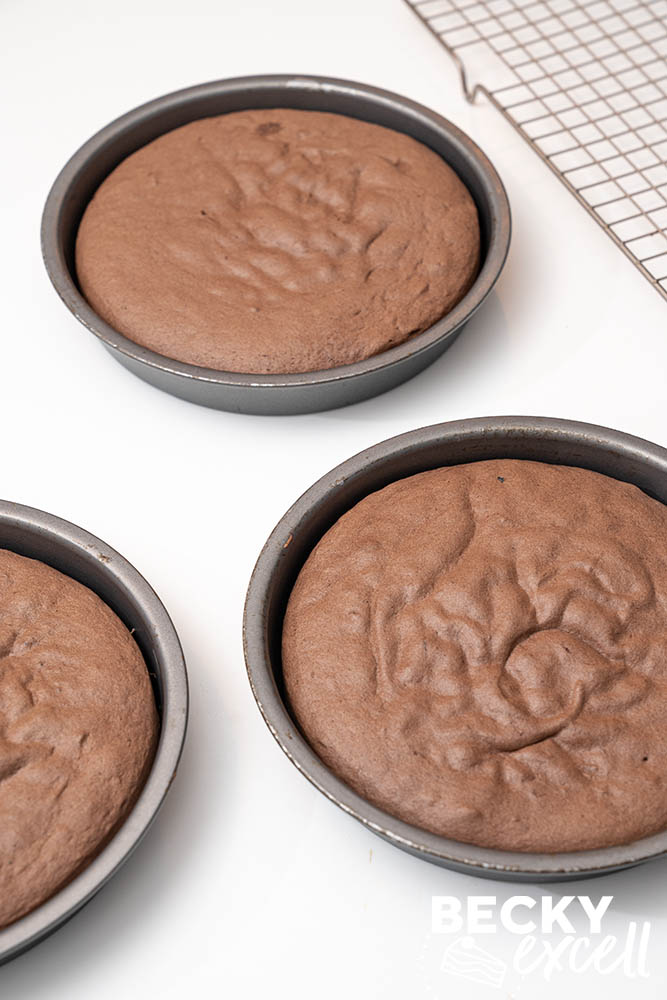
- Two 8in (20cm) round sandwich tins: 25–30 minutes. Think of a classic Victoria sponge or my coffee and walnut cake here.
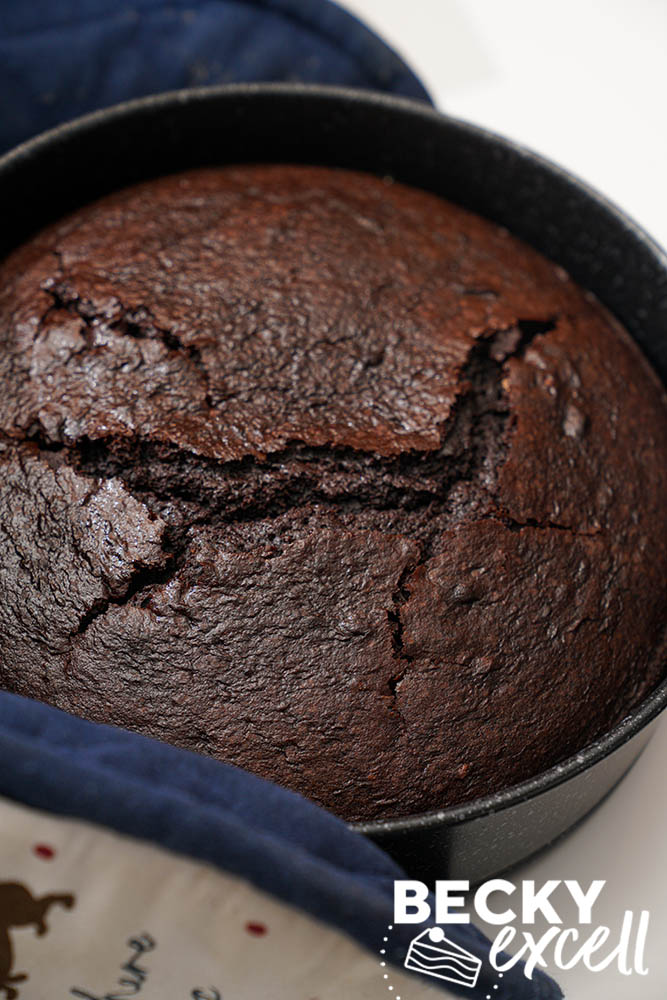
- One deep 9in (23cm) round tin: 45–50 minutes. My chocolate stout cake is all baked in one tin. I start checking this one at around 42–45 minutes. A few moist crumbs on the skewer are fine, but there shouldn’t be any wet cake mixture.
- A tray of standard cupcakes: 20–25 minutes. My vanilla cupcakes are handy to look at if you’re turning a vanilla sponge into cupcakes. My lemon and triple chocolate cupcakes spend about the same time in the oven too.
- A rectangular sponge traybake, around 32 × 21.5cm to 33 × 23cm: 45–60 minutes. This is the sort of tin I use for my school dinner sponge and coffee and walnut traybake. One big cake to cut into little squares once it’s cooled!
- A 9in (23cm) square sponge cake: around 40 minutes. My French fancies start life as one big square sponge. I’ve also popped the quantities and timing for a square version of my school dinner sponge in that recipe’s notes.
- A 2lb loaf cake: 45–60 minutes. My vanilla loaf cake is usually ready towards the quicker end of that range. My banana bread tends to keep me waiting the full hour!
Use these as a guide for similar mixtures and depths of cake. A much deeper cake may need longer. Keep the original recipe’s oven temperature as a starting point, begin checking a little before the suggested range and follow the recipe’s checks for doneness. For a typical sponge, a skewer inserted into the centre should come out clean, without wet mixture. Brownies, cheesecakes and rich fruit cakes need their own timings and checks.
Should I multiply the buttercream, jam and decorations too?
You can use the multiplier as a starting point, but the amount of icing or filling you need depends on how you’re assembling the cake.
Covering the top, filling several layers and piping generous cupcake swirls all use different amounts. Scale the sponge first, then consider how much you need for the decoration you’ve chosen.
Can I round the new ingredient quantities?
For ingredients such as flour, butter and sugar, rounding to the nearest gram is usually fine. You don’t need to persuade your scales to measure 126.56g of butter!
Be more precise with small quantities of baking powder, bicarbonate of soda and xanthan gum. These need scaling too, and rounding a small amount to the nearest whole teaspoon can change it quite a lot. Use suitable measuring spoons or scales that can measure the amount accurately.

Does this work for gluten-free cakes?
Yes! The calculation works the same way for gluten-free cake recipes. You’re adjusting the amount of mixture needed for the tins while keeping the recipe’s ingredient proportions.
Start with a recipe written for the ingredients you’re using, though. Changing the tin size doesn’t make wheat flour and gluten-free flour interchangeable.
Can I use it for any type of cake?
It’s most useful for everyday sponge and loaf cakes. Recipes such as cheesecakes, rich fruit cakes and delicate whisked-egg cakes can need more specific advice about tin depth, baking and cooling.
Ring-shaped, Bundt and novelty tins also have shapes this calculator doesn’t account for. For those, follow advice for the particular recipe and tin rather than choosing the nearest-looking option.
Why do 20cm and 8 inches give slightly different results?
Recipes and tin labels often use the two sizes interchangeably, but 8 inches is actually 20.32cm. The calculator uses the measurements you enter, so the results can differ slightly.
If the recipe specifies 20cm, select centimetres and enter 20. If it specifies 8 inches, select inches and enter 8. For your own tin, measuring the inside will give you the clearest starting point.